Referee Assignment Patterns and Their Links to Pre-Event Valuation Tweaks in Team and Individual Athletic Fixtures
Written by Taylor Richter · Nov 5, 2026
Referee Assignment Patterns and Their Links to Pre-Event Valuation Tweaks in Team and Individual Athletic Fixtures
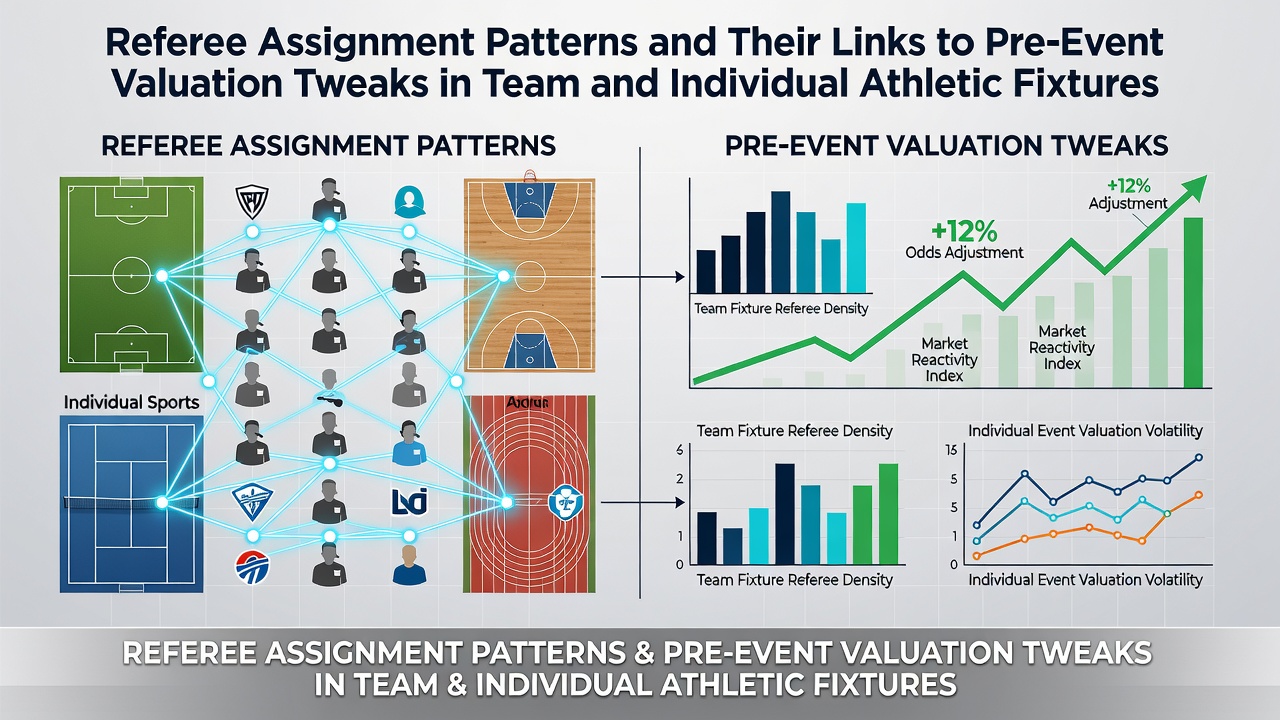
Referee assignment patterns create measurable shifts in pre-event valuations across team and individual athletic fixtures, and analysts track these changes through historical data sets from leagues worldwide. Patterns emerge when governing bodies release official lists weeks or days before matches, allowing betting markets to recalibrate implied probabilities based on known tendencies of specific officials. In soccer, basketball, and tennis events, observers note that certain referees correlate with higher foul rates or point spreads, prompting line adjustments before the opening whistle.
Assignment Protocols and Data Tracking
Leagues publish assignment schedules through centralized systems, and researchers compile these into databases that link each official to past performance metrics such as cards issued, free throws awarded, or set-piece decisions. European football federations maintain public rosters updated monthly, while North American leagues release weekly schedules that feed directly into analytics platforms. Those who monitor these releases find that repeat pairings between referees and teams often produce consistent statistical footprints, which valuation models incorporate when generating opening lines.
Effects in Team Sports Contexts
Team fixtures show pronounced valuation tweaks when assignments favor officials with strict enforcement histories. Basketball leagues demonstrate this through foul-rate differentials, where referees averaging above 22 personal fouls per game trigger adjustments to player prop markets and team totals. Soccer competitions exhibit similar responses, particularly in matches involving high-pressing sides that draw more stoppages under certain arbiters. Data from multiple seasons indicates that these patterns hold across domestic and international calendars, with markets reflecting updated probabilities once assignments become public.
Patterns Observed in Individual Athletic Events
Individual sports like tennis and golf present distinct referee and umpire influences because single athletes interact directly with officials on line calls, time violations, and equipment checks. Assignment rotations in grand slam tournaments and PGA events produce valuation changes when umpires with higher overrule rates appear on specific courts or holes. Analysts cross-reference these officials against surface types and player styles, revealing correlations that betting operators integrate into pre-event pricing. November 2026 schedules for late-season tennis events already show preliminary umpire allocations that have prompted early line movements in select markets.

Studies from academic institutions document how these individual-sport adjustments differ from team environments because fewer variables dilute the official's impact. One paper published through the University of Sydney's sports analytics group examined ATP and WTA assignments over five years and identified measurable shifts in game totals tied to specific chair umpires. Markets respond by tightening or widening spreads accordingly, and traders monitor assignment announcements as primary inputs for model recalibration.
Valuation Model Integration
Quantitative teams incorporate referee profiles into multi-factor algorithms that weigh officiating history alongside team form, travel schedules, and venue specifics. When assignments deviate from expected norms, such as when a high-card issuer replaces a lenient counterpart, pre-event lines adjust within hours. Canadian regulatory reports on market integrity highlight that transparent assignment data reduces information asymmetry, allowing operators to maintain consistent pricing frameworks. Observers note that these tweaks occur most visibly in midweek fixtures where public attention remains lower until assignments finalize.
Cross-sport comparisons reveal that basketball adn soccer markets react faster to referee news than tennis or golf because team-based scoring amplifies small officiating variances into larger point differentials. Yet individual events still register adjustments, especially in high-stakes matches where a single disputed call can alter outcomes. Research from the German Sport University Cologne tracked Bundesliga referee assignments and found consistent links between official identity and over/under totals, data that valuation engines now process automatically upon schedule release.
Conclusion
Referee assignment patterns supply a verifiable input for pre-event valuation adjustments in both team and individual athletic fixtures. Leagues continue to standardize release procedures, while analytics platforms refine models that translate these patterns into probability shifts. As November 2026 approaches with its cluster of international and domestic events, ongoing data collection will further clarify the strength and consistency of these connections across global competitions.