How Weather Patterns Influence Mid-Season Line Movements in UK Horse Racing and Cricket World Cup Markets
Written by Ulrich Powell · Aug 26, 2026

How Weather Patterns Influence Mid-Season Line Movements in UK Horse Racing and Cricket World Cup Markets
Weather systems across the British Isles reshape betting markets in ways that extend well beyond simple rain or shine forecasts, and those shifts become most visible during mid-season windows when lines adjust in real time. Observers tracking UK horse racing note that ground conditions change rapidly under persistent low-pressure systems, while Cricket World Cup fixtures respond to atmospheric moisture that alters pitch behavior and player output. Data compiled by meteorological agencies shows these patterns create measurable movements in odds because bookmakers recalibrate probabilities as forecasts update.
Atmospheric Drivers in UK Horse Racing
Frontal systems moving across racing regions in the UK often arrive with little warning during summer campaigns, turning firm ground soft within hours and forcing trainers to scratch runners whose profiles suit different surfaces. When this occurs mid-meeting, markets react within minutes because the pool of viable contenders narrows and pace expectations shift. Research from the European Centre for Medium-Range Weather Forecasts indicates that accurate 48-hour precipitation outlooks reduce the frequency of late scratches, yet residual uncertainty still prompts line adjustments as layers of data feed into pricing models.
Wind direction adds another variable because gusts along straightaways can either assist or hinder front-runners depending on the track orientation. Punters and syndicates who monitor anemometer readings at course level sometimes identify edges before wider markets fully incorporate the information, resulting in incremental drifts that accelerate once official weather bulletins confirm sustained conditions.
Cricket World Cup Market Responses
During Cricket World Cup cycles, humidity levels and cloud cover directly influence swing and seam movement, particularly in morning sessions where dew point readings dictate how much assistance bowlers receive. In August 2026, several group-stage matches demonstrated how rapidly updated forecasts for afternoon thunderstorms prompted market makers to shade totals downward even before teams took the field. Line movements in these windows often exceed typical margins because limited-overs formats leave little room for recovery once rain interruptions truncate innings.
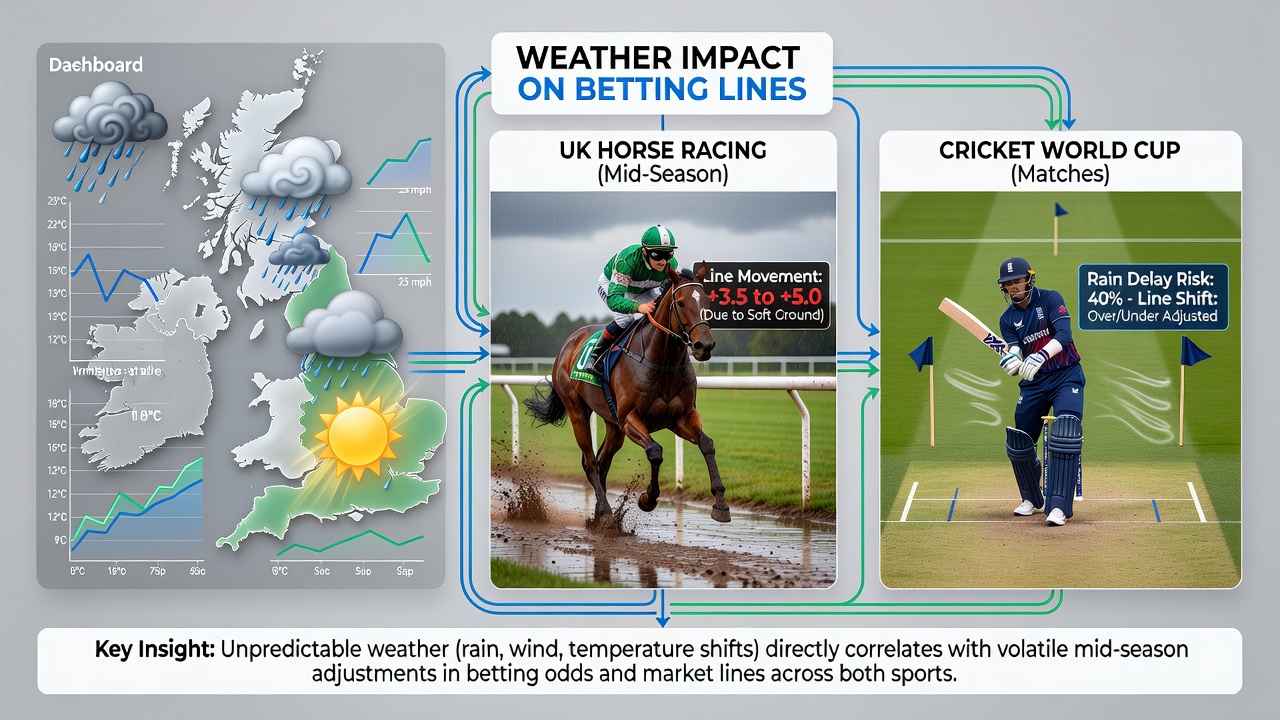
Betting operators adjust over-under lines on run rates and wicket tallies when radar imagery shows incoming cells, yet the timing of those adjustments varies by jurisdiction because different operators weight forecast confidence intervals differently. One study published by researchers at Monash University examined historical World Cup data and found that matches played under variable cloud regimes produced outcome distributions that deviated measurably from pre-tournament models, prompting sharper revisions once live conditions became clearer.
Timing and Velocity of Line Adjustments
Mid-season movements accelerate when multiple weather variables converge, such as simultaneous temperature drops and wind shifts that affect both turf firmness and ball carry. In horse racing, these overlaps often appear between 48 and 24 hours before post time, creating a window where early movers secure positions before the market settles. Cricket markets display similar compression around weather decision points, especially when Duckworth-Lewis calculations enter play and force recalibration of remaining overs.
Industry reports from the National Oceanic and Atmospheric Administration highlight how ensemble forecast spreads narrow as events approach, reducing the range of probable outcomes and thereby tightening the bands within which lines can reasonably move. This convergence explains why sharp bettors focus on the final 12-hour period before races or matches begin, when atmospheric certainty peaks and line velocity slows.
Conclusion
Weather pattern integration into mid-season pricing continues to evolve as forecast resolution improves and operators refine their models accordingly. UK horse racing and Cricket World Cup markets both demonstrate how ground and pitch variables translate into measurable probability shifts once atmospheric data becomes actionable, yet the precise timing and magnitude of those shifts remain tied to the quality and speed of meteorological inputs available to market participants.