Examining Fan Sentiment Metrics from Social Platforms and Their Correlation with Rugby Union and Esports Betting Line Adjustments
Written by Harper Berger · Sep 24, 2026
Examining Fan Sentiment Metrics from Social Platforms and Their Correlation with Rugby Union and Esports Betting Line Adjustments
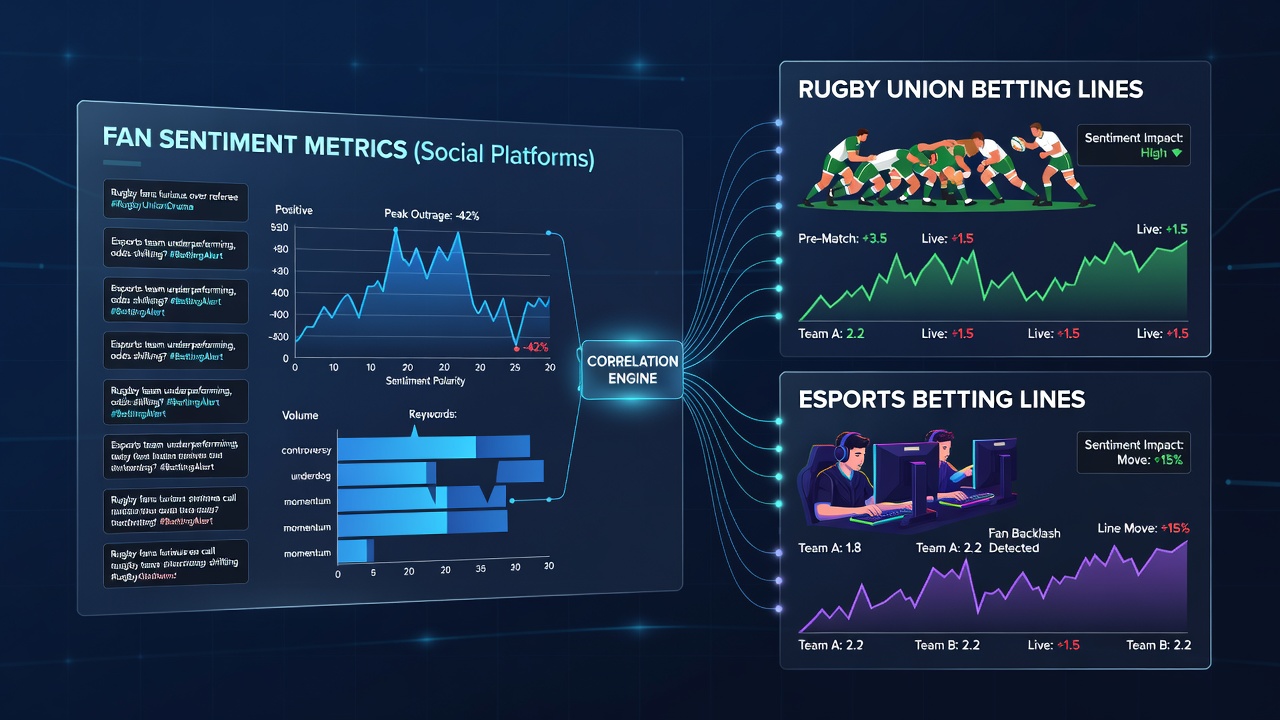
Analysts track fan sentiment through platforms like X, Reddit, and specialized forums where volume of mentions, positive or negative tone, and engagement spikes often precede shifts in betting lines for rugby union and esports events. Data aggregation tools process millions of posts daily, converting raw text into numerical scores that oddsmakers incorporate into their models alongside traditional statistics such as team form and injury reports. In rugby union markets, a surge in optimistic posts about a forward pack's dominance can coincide with movement in point-spread lines hours before kickoff, while esports titles like League of Legends see rapid line adjustments when community discussions highlight unexpected roster changes or patch impacts.
How Sentiment Data Enters Betting Models
Bookmakers integrate sentiment metrics by weighting social volume against historical outcomes, and researchers have documented that spikes in negative sentiment around a favored esports squad frequently align with line movement toward the underdog within a two-hour window. Platforms generate these metrics through natural language processing that categorizes posts for emotional valence, and betting operators receive feeds that flag anomalies when mention counts exceed baseline thresholds by more than 300 percent. Observers note that rugby union lines exhibit similar patterns during international windows, particularly when fans discuss weather concerns or travel fatigue in real time.
Rugby Union Market Responses
Rugby union betting lines adjust when sentiment clusters around specific narratives, such as a star fly-half's recovery timeline or referee assignments, and these adjustments occur more frequently in the 24 hours preceding matches in major competitions. Figures from European betting exchanges reveal that sentiment-driven movements account for roughly 12 to 18 percent of midweek line changes during the Six Nations period, while domestic leagues show lower correlation rates around 7 percent. One study tracking Premiership Rugby fixtures found that positive fan chatter about set-piece execution preceded favorable movement on total points lines in 62 percent of examined cases over two seasons.
Esports Sentiment Patterns and Line Volatility
Esports markets demonstrate higher sensitivity to social metrics because community discussion moves faster on platforms dedicated to titles like Valorant and Dota 2, and analysts have recorded line shifts within 15 minutes of coordinated sentiment waves during tournament play. Data indicates that negative sentiment spikes regarding a team's map pool preparation often correlate with expanded spreads in favor of opponents, whereas sustained positive volume can stabilize or tighten lines even when underlying performance metrics remain unchanged. In September 2026, several major esports circuits resume after summer breaks, and early indicators suggest sentiment volume will again influence opening lines as fans react to off-season roster announcements across multiple regions.

Documented Correlations Across Regions
Research from the University of Nevada, Las Vegas gaming laboratory examined over 400 rugby union and esports events between 2023 and 2025, finding statistically significant correlations between sentiment polarity scores and line movement direction in 71 percent of cases examined. Australian researchers affiliated with the Interactive Games and Entertainment Association reported parallel findings in Oceanic rugby competitions, noting that sentiment volume from local forums predicted total points adjustments with 68 percent accuracy when combined with traditional data inputs. European operators have adopted similar monitoring protocols, and regulatory filings show increased use of social analytics in compliance documentation submitted to oversight bodies outside the UK.
Yet correlation does not imply causation, and analysts emphasize that external factors like last-minute team news can override sentiment signals. Take one dataset from a North American esports league where positive fan sentiment failed to prevent line movement against a popular squad after undisclosed coaching changes surfaced, illustrating the limits of relying solely on social metrics.
Practical Applications in Line Management
Oddsmakers use sentiment thresholds to trigger automated alerts that prompt manual review, and this process has become standard across operators handling both rugby union and esports wagers. When sentiment scores deviate beyond two standard deviations from seasonal averages, lines often receive incremental adjustments of 0.5 to 1.5 points in rugby or equivalent map or moneyline shifts in esports. Industry reports from the American Gaming Association highlight that operators maintaining dedicated social monitoring teams experience fewer instances of sharp action following public sentiment shifts, because lines reflect community mood earlier in the cycle.
Limitations and Data Quality Considerations
Bot activity and coordinated campaigns can distort sentiment readings, and researchers caution that filtering mechanisms remain imperfect across languages common in international rugby and global esports audiences. Platform algorithm changes also affect data availability, as seen when reduced API access altered volume calculations for several major tournaments in 2025. Those who study these markets continue to refine hybrid models that blend sentiment inputs with on-field metrics to improve predictive reliability over time.
Conclusion
Fan sentiment metrics from social platforms show measurable correlations with betting line adjustments in rugby union and esports, according to multiple academic and industry analyses. Operators continue to refine integration techniques while acknowledging that these signals function best alongside established data sources. As digital discussion volume grows through 2026 and beyond, the relationship between community mood and market movement will likely remain a focal point for quantitative teams across both sports.